
Any sufficiently advanced technology is indistinguishable from a religion
We stopped understanding how it works, so we started believing in it instead.

“Any sufficiently advanced technology is indistinguishable from magic.”
Arthur C. Clarke perhaps wrote that as a compliment to engineers, but it speaks volumes about the audience. Magic isn’t a property of the machine but that sense lives in the gap between what a thing does and what you understand about how it does it. This means that the machinery doesn’t have to change at all. Only your ignorance does.
And that gap has never been wider than it is right now. Unfortunately this means we’ve filled it with worship.
Science made the world work
Before the scientific revolution, the world was full of intentions and anthropomorphizing of natural phenomena. Storms had motives, illness had a moral logic and the cosmos had an order built into it with your place in that order.
Science took that apart though, and as a result we got antibiotics, electricity, flight, and a working model of the atom. What we gave up was the sense that any of it means something. The exchange is that science tells you how the world works but it has nothing to say about why it matters that you’re in it.
So that vacancy never got filled, but that doesn’t mean humans ever stopped looking for meaning.
The roadmap is a religious text
Read the AI conversation and you’ll notice that it’s answering the same questions religion has always answered. What happens after you die? Upload your mind. When does everything change? At the Singularity, a dated event after which the faithful are transformed and scarcity ends. Is history going somewhere? Yes, toward superintelligence, and there’s a forecast for the year. How do we make sure the vastly more powerful thing is good to us? That’s alignment, and finally p(doom) which is a probability of damnation quoted to two decimal places.
I’m not calling anyone religious, but notice that the questions came first and God was one answer to them. What survives death, where history is heading, what makes you you, and who gets to decide were never really about God at all, they were always about us. And these days talking about AI and technology will inevitably bring them up because it’s making promises that big.
The technology is real, but the conversation around it has become suspiciously like a religious text. Is it any wonder that some would start treating AI as a religion?
The problem isn’t worship, it’s deference
Deferring to a machine is actually not a new phenomenon and mostly fine. You trust a calculator for good reason: arithmetic is checkable, so if you doubt the answer you can work it out yourself. Chess computers passed the best humans in 1997 and nobody’s mind broke over it, because you can replay the game afterward and see what happened; Deep Blue was better than Kasparov but its search tree was always available for review.
Then in 2016 AlphaGo played a move no professional would have played, and nobody, including the people who built it, could explain why it was good. We called that a win, but it was troubling, because we accepted a decision we couldn’t reconstruct and then celebrated the fact that we couldn’t.
That’s the issue, and it isn’t “the machine is better than me,” which is fine and always has been. The issue is “the machine is better than me and I can’t check its work.”
Here’s where we stand today in arguably the most logical field of study: mathematics. In May 2026 an OpenAI model disproved a conjecture that Paul Erdős posed in 1946 and that most experts believed was true, and the mathematicians who reviewed the result had to publish what they described as a human-digested version of the proof so the rest of the field could follow it. Two weeks later, more than fifteen hundred mathematicians signed a declaration asking for guardrails around AI in mathematical research. Then in June a researcher pointed a model at formalizing that same result and it generated 1.2 million lines of Lean over three weeks, which no human being will ever read.
Mathematics is going to be fine though, and it’s worth understanding why. Lean is a proof checker, so a proof no human can hold in their head still gets verified line by line by a machine whose own correctness we can inspect and argue about. Faced with output beyond human comprehension, mathematicians built the ability to check and convince themselves of the validity of the proof.
So the risk was never that a machine decides to harm us, it’s that machines decide for us and we get worse at deciding for ourselves. At some point in this slippery slope we hand our humanity to the machine.
That’s the plot line to Wall-E, with the humans aboard the Axiom having had everything done for them for so long that they’ve forgotten how to even walk. It’s worth noticing what their recovery took, because even a children’s cartoon built for a happy ending needed a miracle to pull it off: one broken little robot who didn’t do what he was designed to do. Wall-E, as it turns out, is a cautionary tale for p(doom) as much as the Matrix is.
Seeing it doesn’t get you out
I know what’s happening inside most AI systems, roughly. Attention, next-token prediction, a very large pile of stochastic gradient descent, tons of loss functions. Nevertheless despite knowing the chatbot is just a series of matrix multiplications, I’d still say thank you to a chatbot on occasion.
By the way, none of this griping is a case against the tools, and I want to be clear about that. These AI models are the most useful thing to happen in twenty years of being in tech and they’ve changed how I build, how I write, and how fast I get from a vague idea to something I can actually test. I’m not here to tell you it’s autocomplete with a token budget. But what I really can’t stand is the hype. Unfortunately though the hype isn’t a harmless side effect of the tools but is, I fear, the thing standing between you and using them well.
Even knowing all that doesn’t inoculate me, and I still catch myself seeing a demo or reading a company blog post as if the singularity has arrived. Lately though it does seem like more people are asking what exactly is being produced with AI, and not liking the answer. The evidence arriving now is awkwardly split: task-level studies keep finding real gains of anywhere from 14 to 55 percent depending on the work, and yet an NBER survey of nearly six thousand executives across four countries found more than 80 percent reporting no measurable effect on productivity or employment over three years, while PwC’s 2026 CEO survey found only 12 percent saying AI had delivered both cost and revenue benefits. The same NBER paper found that the executives doing the talking use AI about an hour and a half a week. The tools work but it turns out change is slower than what CEOs had hoped for.
The stock market has (finally) started asking. On July 23, 2026, Alphabet reported a quarter that beat on nearly everything, with revenue up 24 percent and cloud revenue up 82 percent, then raised its 2026 capital expenditure guidance to roughly $200 billion. But we still watched the stock close down 7 percent, because free cash flow had gone negative and investors want to know when the spending turns into returns. That isn’t the market deciding AI is fake. It’s the market asking for a reality check for all this AI spending, and it’s the same question you should be asking about your own use of the stuff.
So when we eventually say “remember when we were all delusional about this AI thing?”, that sentence includes me and probably you too.
The airplane of the mind is here
Here’s a piece of technology so extraordinary that we’ve managed to make it boring. You climb into an aluminum tube, sit down with a bad coffee, and a few hours later you’re on a different continent, and the only thing anyone complains about is the legroom. Flying is one of the most miraculous things our species has ever built, and we’ve turned it into a bus with wings.
For a while though, we were certain flight was going to be the answer to everything. For the first twenty years after Kitty Hawk, aviation was mostly prophecy and barnstorming. The Wright brothers themselves thought they’d built a peace machine, on the theory that reconnaissance from the air would reveal what every nation was doing, make surprise attacks impossible, and therefore make war less likely. Orville Wright later acknowledged, more ruefully, that the airplane had not ended war; human beings had simply found new ways to use it in one. Unfortunately, we seem to be particularly creative in turning new inventions into weapons.
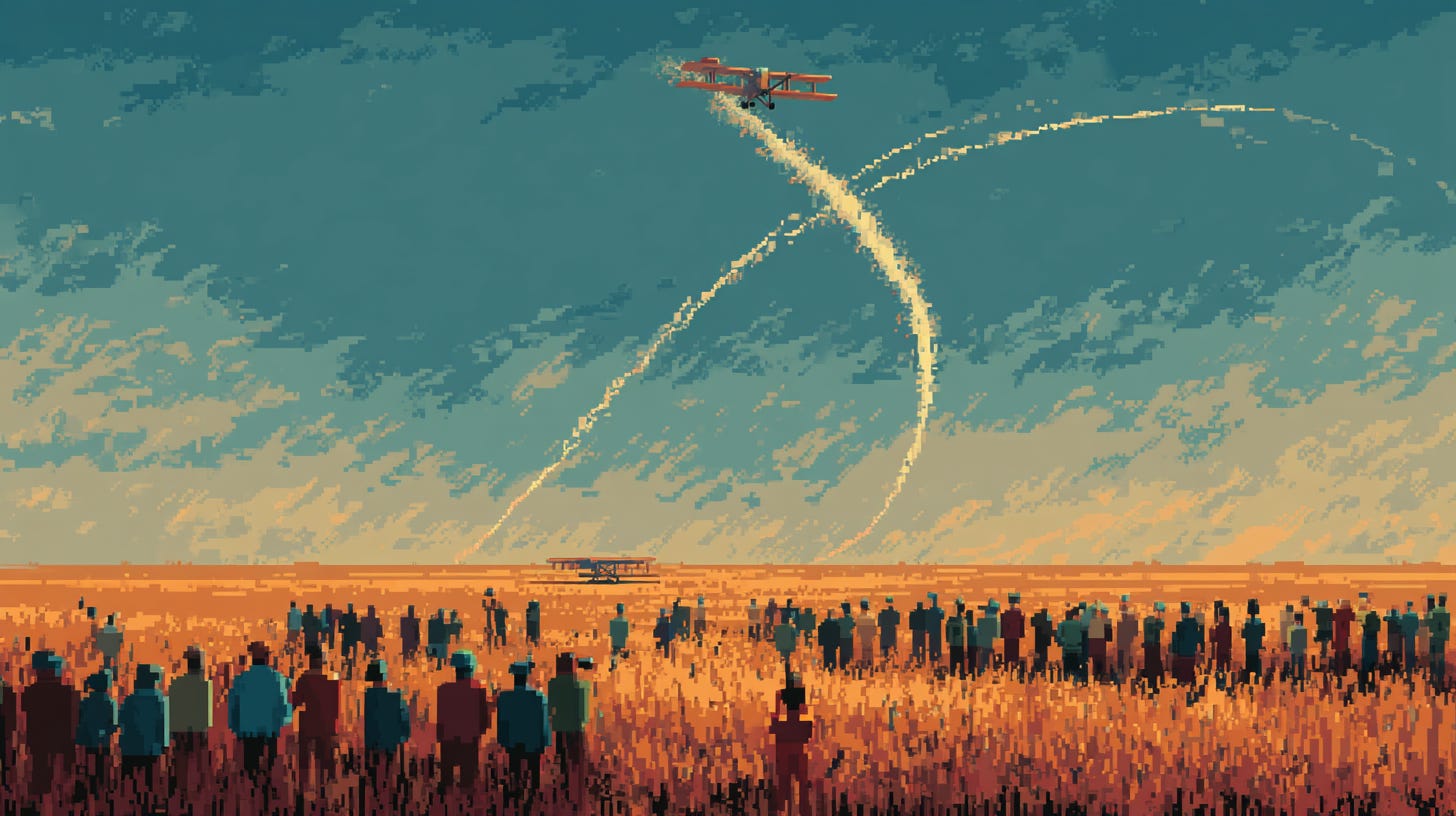
Meanwhile the view from a cockpit convinced a generation of Americans that a new civilization had dawned and the pilot was the man building it. Crowds stood in fields with their heads tilted back, watching someone do a loop through the sky.
The prophecy was wrong but don’t forget: the flying machine was real, is real. But it’s boring technology now.
What changed the world wasn’t the manifesto. It was airmail contracts, cargo routes, and air travel. Barnstorming didn’t end because audiences got bored, it ended in 1926 when Coolidge signed the Air Commerce Act, bringing pilot licenses, aircraft certification, airways, and safety rules to an industry that had largely governed itself. The stunt era gradually gave way to a profession with standards. Aviation began to matter most when people stopped gathering to watch airplanes and started using them to get somewhere.
We’re in AI’s barnstorming years. Look at how much of the discourse in AI is spectatorship: timeline debates, benchmark theater, screenshots of a model saying something eerie, arguments about whether it’s “really” thinking. Everyone’s head is tilted up but that’s not what we should be doing.
Watching the loops won’t tell us what this technology becomes.
Get in the cockpit instead.
Start by accepting that this isn’t the end of the world or the start of utopia. Every hour spent treating it as one or the other is an hour not spent doing anything useful. Doom and hype are the same posture facing opposite directions: either way, you end up standing still, head tilted toward the sky, mouth agape.
Then learn to fly it. I mean hours in the seat, not hours reading about the seat. The capability everyone is arguing about is already sitting there, and almost nobody is putting in the time.
The highest leverage is to build one level deeper: not solutions but solution-makers. The most important use of AI is not drafting another document. It is building the bespoke software that fits your exact situation and that nobody else would ever build for you; the workflows, agents, and skills that can keep solving the problem after the conversation ends.
Talking to a chatbot is useful (heck I do it all day) but it is mostly one-to-one: one problem, one answer. A program or workflow written for you can run tomorrow morning, and the morning after that. A good agentic workflow can be reused, tested, and improved. Use the strongest models not merely to answer questions, but to build systems that keep working even if the oracle disappears.
For example, watch what happened during Anthropic’s mythical Fable model release (sorry I couldn’t help myself). During Fable’s on-again, off-again availability due to security and regulation concerns, the genuinely useful advice going around was this: use the window to audit and improve your setup, have it write your skills, have it plan the projects that lesser models can execute later. In other words, use these AI models as the tools they are meant to be: to build things that keep working even if the oracle leaves or is taken away.
Properly evaluate tasks you are repeating. Split what you use it for into two piles: the one-off things and the things you’ll do over and over.
The one-offs mostly do not matter. If a model summarizes a document you will never open again or chooses a restaurant for Friday, being unable to reconstruct the answer costs you little.
Repeated work is different. You will do it next week and the week after that. Anything in this pile should be something you can recreate, genuinely understand, and test when it changes. That might mean writing software, constructing a proof, maintaining a spreadsheet, or producing a recurring analysis. You need to know what mediocre, good, and excellent look like - and how to work with AI to reach excellent repeatedly. I would insert some discussion about loop engineering at this point, but I’m afraid to ask.
But keep doing some of it by hand. Write something longhand with a pen on paper, take a story from blank page to finished draft without any help at all, and sit down and write the code the old-fashioned way of typing it into vim. This isn’t principle and it isn’t nostalgia, it’s that those are the muscles you’ll want to continue building and maintaining. Nobody on the Axiom in Wall-E lost the ability to walk in an afternoon, they just stopped walking, and eventually the ability was gone.
Remember you don’t owe deference to anything that can’t explain itself. Certainly not to an algorithm, and definitely not to the people selling you one.
We now have the airplane of the mind.
Stop tilting your head up and just go fly the thing.
Isaac Asimov predicted all of this. Foundation gave us psychohistory, a new science developed with the advent of planetary computer networks that allowed human behavior to be predicted by analyzing historical trends. The Feeling of Power had humanity forget how calculators work until someone reverse engineered one and reinvented mathematics. And The Last Answer proposed that God might actually be a time traveling AI similar to Roko's basilisk, created by humans to determine whether it's possible to undo the heat death of the universe - only figuring it out once humanity is long dead, and announcing the answer by saying "let there be light"!