

(For those who are fervently against crypto, consider unsubscribing from the “About Crypto” section so that you only receive content that you enjoy - life’s too short to not enjoy your inbox!)
I have been meaning to write more about crypto for a while. This isn't new information, but I feel it's important that I talk about crypto in the way I understand it. And I have three series to dive into:
Bitcoin: Digital Gold
Ethereum: The World's Computer
Building the New Financial System
I had already started to scratch the surface of Ethereum possibly becoming part of financial infrastructure, but I realize that I need to, in a manner of speaking, start from the beginning. Why do cryptocurrencies even make sense in monetary history?
Let's play this out in three series (Bitcoin, Ethereum, Financial System), each with three parts, starting with the cryptocurrency that started it all: Bitcoin.
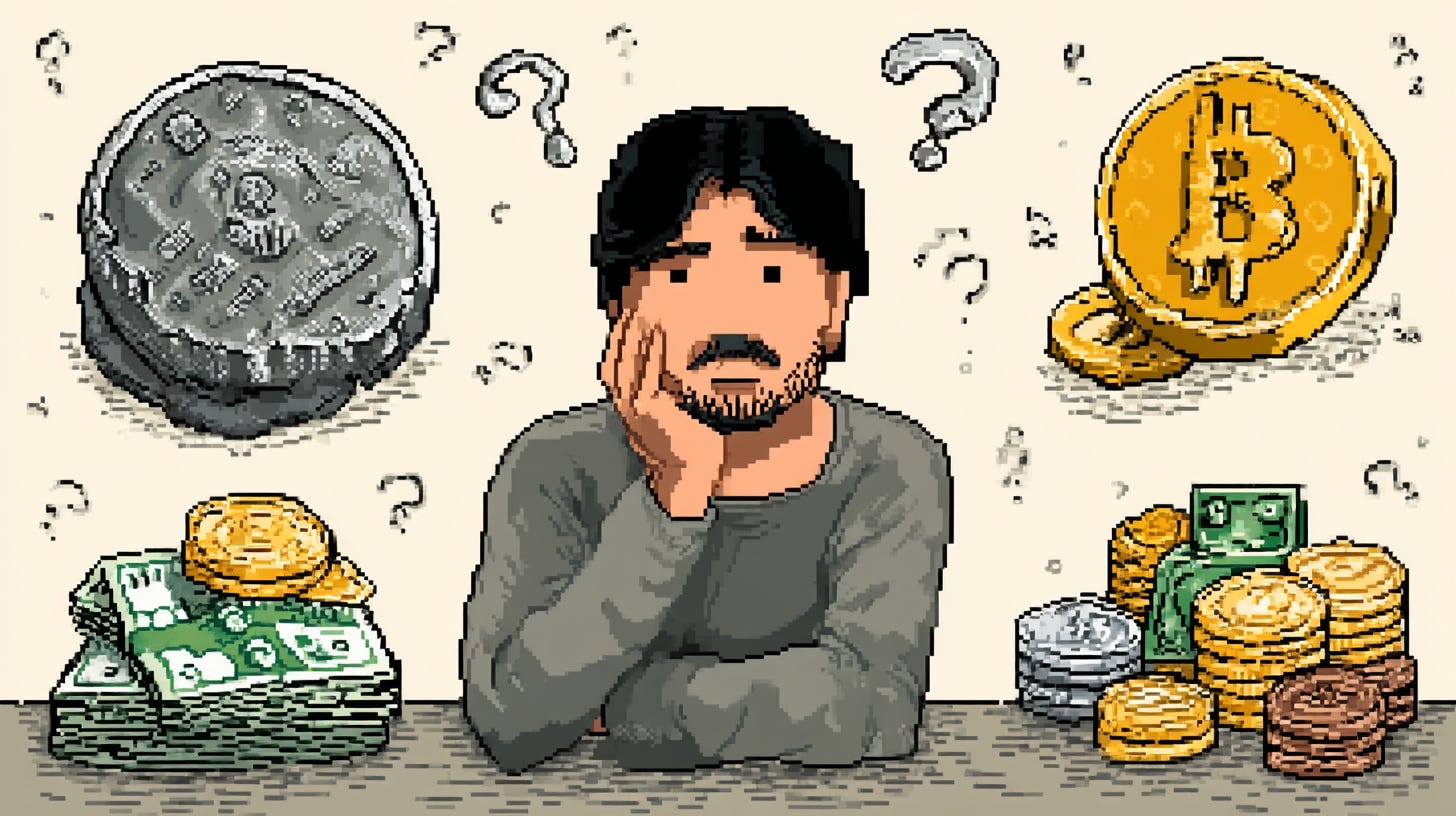
Bitcoin's transformation from cryptographic experiment to institutional asset represents one of the most dramatic shifts in monetary history. I aim to cover Bitcoin in three parts that build on each other to walk through why the world's first cryptocurrency became part of the biggest financial innovation of the 21st century.
Part I: The Monetary Revolution traces Bitcoin's emergence during a time of monetary debasement. From the Rai stones of Yap Island to the collapse of Bretton Woods, humanity has struggled to maintain sound money against the persistent threat of inflation. Bitcoin's breakthrough - combining cryptographic security with absolute scarcity - offers the first technologically-enforced monetary policy in history. We examine how Bitcoin's superior monetary properties position it to succeed where every previous form of money has ultimately failed.
Part II: The Institutional Transformation explores Bitcoin's rapid legitimization through institutional adoption. The approval of spot ETFs, corporate treasury strategies pioneered by MicroStrategy, and the emergence of sovereign Bitcoin reserves mark Bitcoin's transition from speculative asset to portfolio cornerstone. We analyze how $100+ billion in ETF assets, pension fund allocations, and nation-state accumulation create self-reinforcing adoption cycles that make Bitcoin's continued growth increasingly inevitable.
Part III: The Network Effect investigates the technical and economic forces driving Bitcoin toward global monetary dominance. From Lightning Network's scaling solutions enabling instant global payments to the supply shock mathematics of lost coins and institutional accumulation, we examine Bitcoin becoming a hard asset. The convergence of technological maturity, regulatory clarity, and network effects suggests Bitcoin will achieve in decades what gold accomplished over millennia.
Together, I hope to paint Bitcoin as a new asset class that is fundamentally different from previous forms of money - one that is governed by mathematical laws that no government can manipulate.
Let’s start at the beginning…
Part I: The Monetary Revolution
To understand Bitcoin's emergence as a new type of money, it's instructive to examine the monetary events through decades, centuries, and even millennia.
Bitcoin's Genesis
September 15, 2008 marked the day Lehman Brothers filed for Chapter 11 bankruptcy protection, triggering the most severe financial crisis since the Great Depression. With over $600 billion in assets evaporating overnight, the global financial system teetered on collapse. Central banks worldwide responded with unprecedented monetary experiments - quantitative easing, negative interest rates, and bailouts that socialized losses while privatizing gains. It was within this financial meltdown when Satoshi Nakamoto released the Bitcoin whitepaper on October 31, 2008, proposing a "peer-to-peer electronic cash system" (a surprisingly readable whitepaper which I encourage readers to read if they haven't before) that would operate without any central authority.
The genesis block, mined on January 3, 2009, contained a message that crystallized Bitcoin's purpose: "The Times 03/Jan/2009 Chancellor on brink of second bailout for banks". Satoshi introduced a monetary system with rules that could never be changed - a declaration of war against a financial system where supply could be inflated at will and control remained centralized.
A Long Time Ago…
To understand Bitcoin's monetary nature, we first examine humanity's 5,000-year struggle to maintain sound money. Every form of money throughout history has followed a predictable lifecycle: adoption as a store of value, acceptance as medium of exchange, debasement by authorities, and eventual collapse. See "Understanding Money Using Historical Evidence". Bitcoin is distinct in its technological enforcement of scarcity.
The Rai stones of Yap Island offer a fascinating historical parallel to Bitcoin's blockchain. These massive limestone discs, some weighing four tons, functioned as currency not through physical exchange but through communal memory. When ownership changed, the entire community would witness and remember the transaction - the stones themselves rarely moved. This shared consensus mechanism, where value transfer occurred through collective agreement rather than physical possession, predates Bitcoin's distributed ledger by centuries.
However, the system collapsed when David O'Keefe arrived in 1871 with modern tools, mass-producing Rai stones and destroying their monetary properties through inflation. This demonstrates a principle: when money production costs fall below face value, debasement inevitably follows.
The Roman Empire's monetary decay tells a similar story. The aureus, a gold coin of ancient Rome, contained 8 grams of gold under Augustus but shrank to 5.5 grams by Diocletian's reign. The denarius fared worse - by 275 AD, it contained only 5% of its original silver content. This debasement drove prices up 70-fold over two centuries, contributing to the Empire's eventual collapse. This pattern repeated across civilizations: from China's paper money experiments in the 11th century to John Law's Mississippi Bubble in 18th-century France, every attempt at monetary manipulation ended in disaster.
Modern fiat currencies have compressed this debasement timeline from centuries to decades. The Weimar Republic's hyperinflation saw the mark collapse from 48 per dollar to one trillion per dollar by November 1923. Zimbabwe hit 79.6 billion percent monthly inflation in November 2008, while Venezuela exceeded 2,000,000% inflation. Even "stable" currencies suffer: the U.S. dollar has lost 96% of its purchasing power since 1913, with 88% of that loss occurring after 1971.
The Nixon Shock
On August 15, 1971, President Nixon suspended dollar-gold convertibility and moved the world away from the gold standard that had governed commerce since Isaac Newton established it in 1717. Under Bretton Woods (1944-1971), the dollar was pegged to gold at $35/ounce, with other currencies pegged to the dollar. This constraint on money printing had enabled the post-war economic miracle.
The removal of this constraint unleashed monetary chaos that continues today. The M2 money supply exploded from $600 billion in 1971 to $21.94 trillion today - a 36.6-fold increase that far exceeds economic growth. Gold, artificially suppressed at $35, now trades above $2,600 - revealing the dollar's 98% devaluation against humanity's oldest monetary metal.
The Cantillon Effect, where those closest to money creation benefit before prices adjust, has created unprecedented wealth inequality. Asset owners prosper through monetary expansion while wage earners fall behind. Housing, education, and healthcare costs have soared multiples above general inflation. The middle class, once America's defining feature, struggles to achieve markers of prosperity their parents took for granted. Global debt now exceeds $300 trillion - over 330% of global GDP - as governments attempt to paper over structural problems with printed money.
Bitcoin's Technical Breakthrough
Here's where things get interesting. Satoshi Nakamoto didn't just complain about the financial system - they actually built something better. The innovation was solving the double-spend problem that had plagued digital currency attempts for decades. Think about it: digital information can be copied infinitely. How do you create digital money that can't just be copy-pasted?
Satoshi's genius was combining existing technologies - cryptographic hashing, digital signatures, peer-to-peer networking, and proof-of-work - into something entirely new. By requiring miners to burn actual electricity to validate transactions, Bitcoin created something previously impossible: digital scarcity. (If you haven't yet, seriously read the Bitcoin whitepaper - it's only 9 pages and surprisingly accessible.)
The difficulty adjustment algorithm, recalibrating every 2,016 blocks, keeps the system humming along at a predictable pace no matter how much computing power joins or leaves the network.
But here's the kicker - by design: the 21 million coin cap is immutable. Not "probably won't change." Not "subject to governance votes." Immutable. Period. The halving schedule cuts new supply every four years like clockwork: from 50 BTC per block (2009-2012) to 25 (2012-2016) to 12.5 (2016-2020) to 6.25 (2020-2024) to the current 3.125. By 2140, we're done. The last satoshi will have been mined.
This kind of predictability? It's never existed in money before. Economic genius, madness, or futility?
Bitcoin's Monetary Properties
To evaluate Bitcoin as money, we need to examine its fundamental monetary characteristics against both traditional and digital alternatives:
Scarcity: Bitcoin's 21 million cap is algorithmically enforced - no entity can alter this limit. Gold supply increases approximately 2% annually through mining. Fiat currencies face no hard constraints - M2 money supply expanded 40% during the COVID pandemic, demonstrating the elasticity of politically-controlled money.
Divisibility: Each bitcoin contains 100 million satoshis, enabling transactions as small as $0.0003 at current prices. Gold requires physical subdivision with associated costs and practical limitations. While digital fiat matches this divisibility, physical cash cannot compete at micro-transaction levels.
Portability: Bitcoin transfers settle globally in 10-60 minutes for fees typically under $2. Gold transport requires insurance, security, and regulatory compliance costing 0.5-2% of value. International wire transfers require 1-5 business days with fees averaging 3-4% through traditional banks.
Durability: Bitcoin exists as distributed information across thousands of nodes - destruction would require eliminating every copy simultaneously. Gold resists chemical degradation but faces physical risks of loss or theft. Paper currency degrades over time and requires regular replacement.
Verifiability: Bitcoin transactions can be independently verified through open-source software on consumer hardware. Gold authentication requires specialized assaying equipment and expertise, with sophisticated tungsten forgeries fooling basic tests. Modern currency anti-counterfeiting relies on specialized detection equipment most businesses lack.
Stock-to-Flow: Bitcoin's existing supply to annual production ratio stands at 57, increasing to 103 after the 2028 halving. Gold maintains a ratio around 62, accumulated over millennia. This metric quantifies monetary hardness - higher ratios indicate greater resistance to supply dilution. Bitcoin's programmatic halvings ensure increasing scarcity over time, a property no other monetary asset possesses.
Network Effects and Adoption Dynamics
The network has grown to 100-200 million users globally, moving $10-30 billion daily. Sure, the top 100 addresses hold 14-15% of supply, but that's actually way better than traditional wealth where the top 1% control over 30%.
What fascinates me is how Metcalfe's Law applies here. Each new user doesn't just add value linearly - they make the network exponentially more valuable for everyone else. It's the same dynamic that made Facebook unstoppable, TCP/IP the backbone of the internet, and now it's happening with money. Once this snowball starts rolling, the value grows exponentially.
The Market's Verdict
We've come a long way from the 10,000 BTC pizza purchase in May 2010 quoted as $41 at the time of the offer (ouch). Bitcoin now commands a $2.2-2.3 trillion market cap. To put that in perspective, Bitcoin would need to hit $742,000 per coin to match gold's total value. Not saying it will, but... the math is there.
What's interesting is how Bitcoin has evolved. Satoshi envisioned peer-to-peer cash, but the market decided differently. Like gold, which sees only 7% industrial demand with the rest held for wealth preservation, Bitcoin has become "digital gold."
The Thermodynamic Foundation
This is the part that makes environmentalists angry, so let's talk honestly about energy. The network runs at 1+ zetahashes per second. That's an incomprehensible amount of computing power, and yes, it uses energy - 120-170 TWh annually.
But here's what the critics miss: this isn't waste, it's the whole point. That energy consumption IS the security. You can't fake proof-of-work. You can't print electricity. The energy creates an unforgeable link between the digital and physical worlds.
Plus, Bitcoin mining runs on 55% renewable energy - way cleaner than most industries. Miners chase cheap energy, which means they're monetizing stranded resources - flared gas in North Dakota, excess hydro in Iceland, curtailed solar in Texas. And when you factor in the entire infrastructure, Bitcoin is 56 times more efficient than traditional banking.
Look, I'm not going to pretend Bitcoin's energy use is trivial or that it's some environmental savior. It uses about as much electricity as Argentina. That's real. But it's also securing $2 trillion in value and providing uncensorable money to millions of people. Is that worth it? Honestly, the market seems to think so, but reasonable people can disagree. The renewable percentage is improving, the efficiency per transaction keeps getting better with Lightning Network, and miners have incentives to find the cheapest (often cleanest) energy available. It's not perfect, but it's not the disaster critics paint it as either. Time will tell if the tradeoffs are worth it.
The Sovereignty of Mathematics
Here's what really blows my mind about Bitcoin: it's the first money in history that runs on math instead of trust. Think about that for a second. Every other form of money requires you to trust someone - the Fed, your bank, your government. Bitcoin? You trust the math. And math doesn't care about politics, borders, or bailouts.
No president can executive-order more bitcoins into existence. No judge can reverse a transaction they don't like. This isn't about being anti-government - it's about having options. It's about knowing that at least some portion of your wealth exists outside the reach of human fallibility and corruption.
And once you realize we can create incorruptible money, you start wondering - what else can we make incorruptible? Property records? Identity verification? Bitcoin opened a door we're only beginning to walk through.
Where This All Leads
So where does Bitcoin go from here? Honestly, I don't know - and anyone who claims they do is selling something. The technology is proven. The adoption is accelerating. The math is immutable. But the path forward? That's still being written.
Maybe Bitcoin slowly absorbs gold's $15 trillion market cap. Maybe it becomes the neutral reserve asset for a multipolar world. Maybe it stays a volatile but essential portfolio diversifier. Or maybe it goes to zero.
What I do know is this: every fiat currency in history has failed. Every government has eventually chosen the printing press over discipline. Every empire has debased its money. The track record is literally 0 for infinity. Bitcoin offers something different - not perfect, definitely not convenient for buying groceries, but mathematically incorruptible in a way that nothing before it has been.
I'm not saying put your life savings in Bitcoin (seriously, don't). But I am saying that ignoring a new form of money that can't be debased, can't be censored, and can't be stopped... that seems like the riskier bet. Every day more people figure this out. Every day the network grows stronger. Every day that bet on mathematical money over political money looks a little bit smarter.
Bitcoin isn't just an investment thesis - it's a bet that humanity is ready for money that plays by rules we can verify rather than promises we have to trust. And with each crisis, each bailout, each "temporary" monetary expansion that becomes permanent, that bet becomes less radical and more rational.
Next article
This is an exploration of Bitcoin’s monetary properties and historical context, not investment advice. Do your own research and consider your personal financial situation and consult your financial advisor before making any investment decisions.