

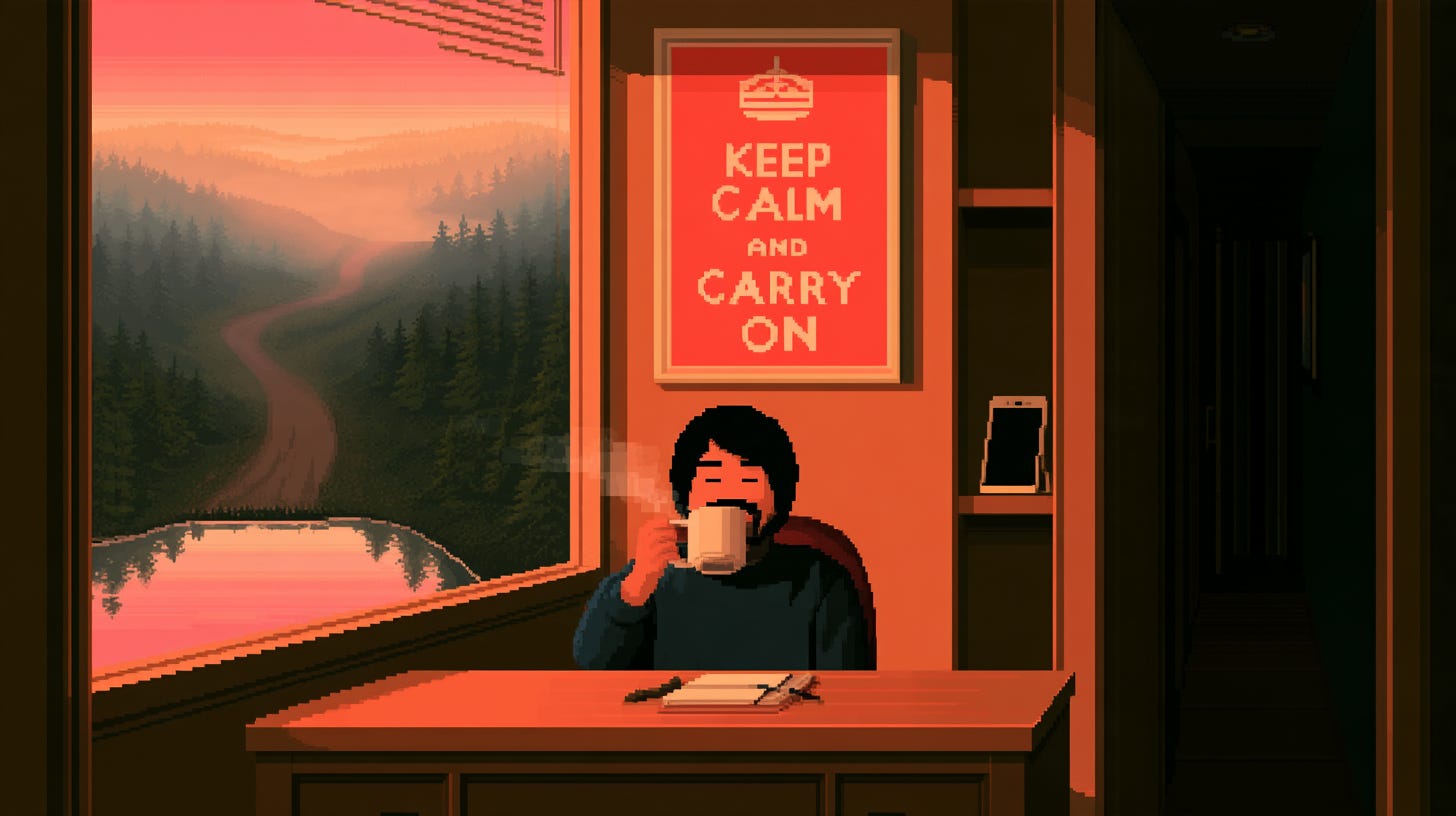
Millions of copies of the “Keep Calm and Carry On” poster were printed by the government in the UK in 1939 but there were actually very few left other than the ones that were discovered by a bookseller among boxes of out-of-print books sixty years later. While it has become a meme, the message behind it should be taken seriously, because it refers to a skill that is immensely valuable and which almost none of us has consciously developed.
Keeping calm is an extraordinary ability. It is a state in which one can experience and return to, and it changes the quality of all decisions made within it. I have written about how anxiety reduces productivity, and this post is about why and how to develop a state of calm under pressure.
What happens when you let fear control your decisions
When you act out of fear, you’re no longer making any decisions. You are acting in accordance with the reaction that is programmed evolutionarily into your brain to save you. This response allows you to focus on the danger that is in front of you and nothing else at the present moment. This is precisely the way that it should work in cases when you’re facing a bear attack, but it’s completely the wrong approach in practically any other scenario and in almost any type of decision that you need to make today.
The changes in how we respond was visible to me when observing different team responses during production outages while in Big Tech. People would usually be scared and panicking, with an immediate desire to run away and hide somewhere. However, what I’ve seen among the best engineers who always responded differently: they were taking some time to think about it and ask “what is going next?” while trying to mitigate the situation and fixing the problem that emerged. That doesn’t mean that they were not afraid. It just means that their fears did not control the decision-making process for them.
And for the more important decisions we have to take, the process goes through the similar cycle but at a slower pace. Before and when leaving Big Tech, I had moments when it felt like something terrible was happening to me in the middle of the night – every time I panicked, and most often the only decision to take was to do everything necessary to make the panic go away – and that wasn’t the right choice. But the good thing about it was that it helped me understand the signal from my nervous system and distinguish it from having just a bad night, and the only way to get rid of it is to calm down enough to recognize it.
Calming down means seeing the whole picture and situation despite all the pressure.
Be clear and content
The type of calmness that should be developed is a state where you start from as a baseline; a state where you live and operate from, and not something you only experience while on vacation. There are two parts: The first one is clarity, which means that you can see clearly what’s happening without any fears in front of you, and contentment helps you be able to judge the situation at hand because you are not constantly striving after things.
In numerous religions, there’s a very old analogy where your mind is a pond filled with murky water. The water gets murkier because of your fears, slack messages, and doomscrolling causes you to not to be able to see what is under the surface of the water. The only way to make the water clearer is to stay still in it, and it is impossible to clarify the murky water by struggling in it. Only by being calm can you see the truth and answers that were there all along.
This is especially important in practice, as calmness and competence are additive. When you have a clear mind, you make the right decisions; when your decisions are right, there will be fewer problems/crises and this way you will have fewer chaotic situations so that the foundation you build will serve you well.
You need to build the foundation of calmness and competence in three different dimensions: in your soul, mind and body.
Calm your soul
The state of peace always starts with the soul (or spirit, or whatever you like to call it): this is the place where everything you love, everything you desire and all your fears reside. It is possible to have a peaceful mind and well-rested body, but still be uneasy because most of the fears have to do with the things that you invest yourself in – whether it is your title, a role, or your image.
Buddhism takes this idea further to show that this is not just an issue that some of us have but something inherent in all of us. Buddha’s solution to suffering is rooted in the belief that craving and attachments, which are holding on to something or avoiding something, cause suffering. That feeling of attachment when it feels threatened is known as fear. It doesn’t take very long for one to begin seeing oneself constantly avoiding this fear, and such realization begins to weaken it because once fear can be seen, it can also be questioned.
Knowing what you stand for is the key to solving it all. Some simple questions to think about:
What kind of life do I want to live?
What do I stand for?
What are the things that I am unwilling to compromise even if it costs me?
Having the answers to those questions, making the hard choices becomes much easier because you can compare them to the something constant rather than how fearful you are on a particular day.
And then decide for yourself what is enough. Wanting more is the silent reason for fear because when you don’t define exactly what is enough, every gain is something to fight for and protect, and every loss becomes a threat, and you cannot stay still while you are running. And when this wanting is focused on other people, it is envy, and social media is unfortunately the source of it these days.
Anger is perhaps the loudest emotion and the one that feels powerful, but there are usually some fears hidden behind it, which getting rid via venting just intensifies, so the best choice usually is to spend some time and think before acting impulsively.
Old memories and traumas muddy the water as well because each of us has those childhood or past experiences that trigger reactions in them. However, if one examines his experience and understands it rationally, either with the help of reflection or therapy, the influence of that event on one becomes smaller. The right question about such experience should be “What you didn’t get in your past?” in order to try to compensate for that and to influence yourself and others around you.
The last suggestion that I have is to try to connect to something bigger and larger than yourself, whatever you might consider to be God or nature or the idea that you’re made of the same material as the rest of the world. Such realization helps a lot, because the result won’t depend on your efforts alone, and it helps you realize that you don’t control everything and thus makes it easier to forgive. Besides, it makes the last step less terrifying, because living in accordance with your principles gives you the courage and dignity, making death less scary or even not scary at all.
Calm your mind
I spent most of my meditation practice with ānāpānasati, meaning awareness of breathing, or vipassanā, meaning the observation of arising and passing sensations and thoughts without clinging to them. Thirty years down the road, my mind continues to wander at all times. What changed is the speed in which I realize that it has wandered and how softly I can get it to come back and focus.
It doesn’t take you thirty years to begin. Spend ten minutes sitting down, focusing on the breath through your nostrils, and whenever you get distracted, just observe where you got lost and bring yourself back without being harsh to yourself. Buddhists refer to the constant chattering as the monkey mind, and the objective is not to get rid of the monkey, since that is impossible, but rather tame it.
Meditation becomes more effective when you refrain from adding and stirring more mud. There are some practices that help:
Read news a couple of days late instead of in real time, because whatever has remained important after three days would still be there, and most of whatever you have missed wouldn’t matter in the first place.
Turn off notifications for email, social media, and texts, and check them at times you choose.
Write down everything that comes to your mind early in the morning without any editing, so that the noise gets dumped onto the paper instead of accompanying you all through the day.
Focus on things that are important but not urgent, because that is where the real work lies.
The point of all of this is simply to live in the present because the past and the future exist only as thoughts, and you can only live and act in the present.
Calm your body
The mind functions through the physical body, and therefore a tired, wired, and sleepy physical body will pull the mind down. Sleep is therefore key because this is where restoration of the mind and body occurs. No amount of caffeine can fix this lack of rest. Drink coffee or tea with this in mind.
It is necessary to do physical activities, but remember to move slowly some of the time. Walking meditation works because when your attention is on your feet and your breath, and therefore there is nothing else to worry about. My easy trail runs do this for me - because there’s no pace to hit, I notice the hill, the breathing, and the light through the trees.
Carve out time by yourself. If you have a family and a career, it may be hard to find extra time for yourself. But instead of booking a weekend retreat in the mountains, you just need to find some time to be alone. For me, it’s the time in morning before everyone else gets up; for you, it might be an afternoon stroll or the few minutes before entering your front door driving in the car.
And finally, please don’t wear your hectic life around your neck like a medal. After all, time is the only resource you can’t get more of, so every single item on your “to do” list takes a portion of your life, and the question to ask yourself is whether it’s worth it.
Keep calm, then carry on
The message in the original UK government poster is right as it starts with calmness. Calmness helps us to have the right perspective about our position while moving ahead with the right perspective and therefore knows the direction in which they should move. Fear will usually be present at the starting point, during the meeting, and even at 3 am. But with the help of calmness, while you cannot remove the fear, you can prevent the fear from taking control.
So take something from this article and experiment this week – take ten minutes to breathe in the morning, switch off notifications, go walking or jogging without the stopwatch goal, and be honest to yourself with what is enough for you. Repeat next week and a few months later when all the dust settles down, and see the things you didn’t see before.
What a perfect start to any day reading this - calmer already.
Great blog👏