

This series of articles is part of my journey aiming for a sub-20min 5K. See my previous articles chronicling 24:43 → 23:47 → 23:20 (this article).
Five weeks ago I ran my second parkrun in 23:47 with a 2-second positive split, and wrote a whole post about pacing finally clicking. Today I ran my third parkrun in 23:20 with a 32-second positive split.

I am excited about the PB, but I am disappointed about the fade and massive positive split.
The race, in two halves
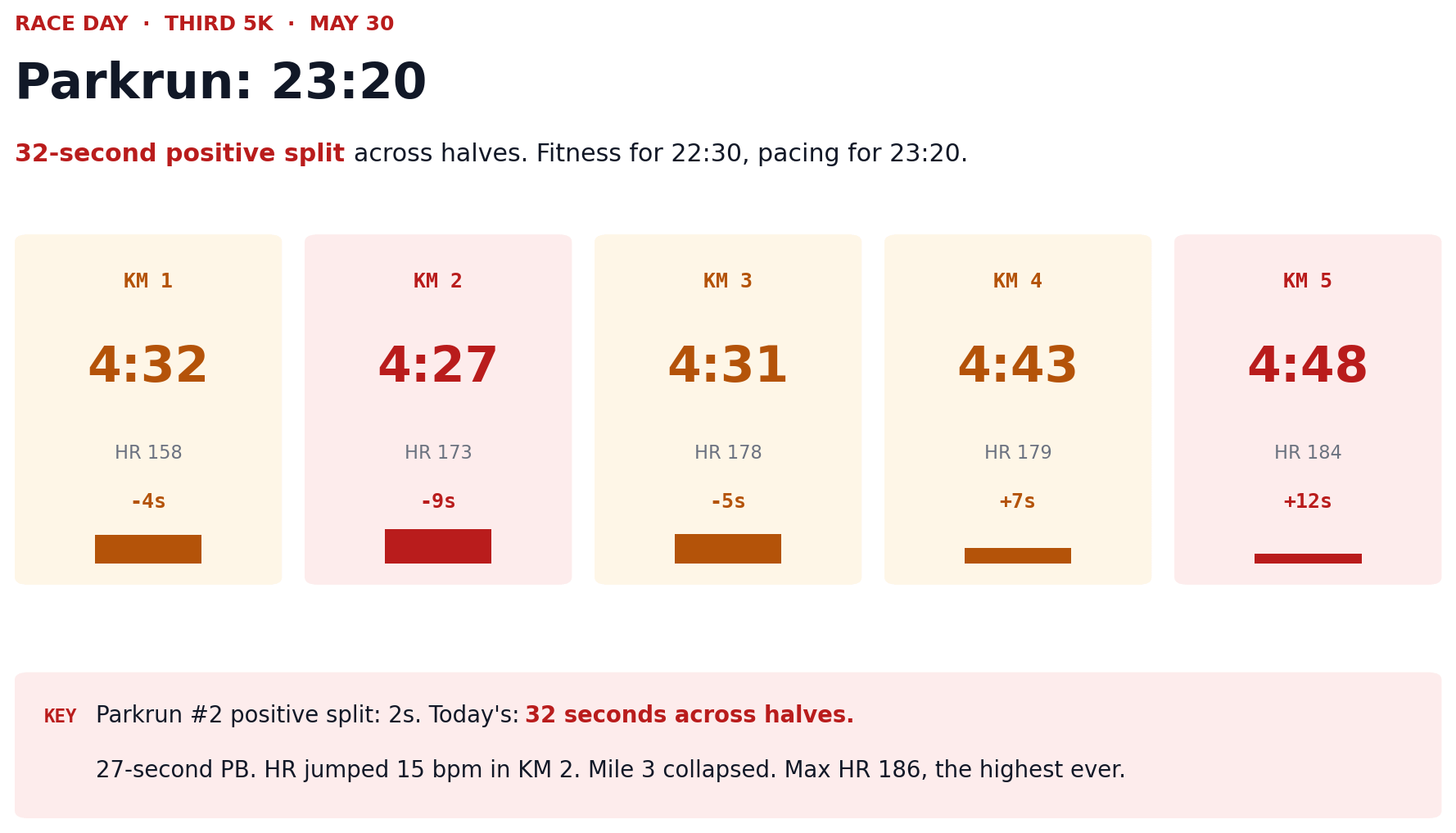
The first two miles were as clean a race execution as I’ve ever put together. Mile 1 at 4:30/km, mile 2 at 4:31/km. Cadence 180+, stride length 1200mm, vertical ratio 7%. These are essentially my best-ever interval biomechanics, sustained for over 3.2km of continuous racing. If I had been able to keep the pace through 5km I would have ran 5K at 22:30. Nice.
Then mile 3 happened, and every biomechanical marker collapsed in lockstep. Cadence fell 6 spm. Stride length dropped 20mm. Ground contact time stretched 12ms. Vertical ratio jumped from 7% to 7.44%. All of this is to say that my running form just went south and I slowed down a lot.
It turns out that the cause was at km 2. 4:27/km in the second kilometer of a 5K is above my lactate threshold and my average HR jumped 13 bpm between mile 1 and mile 2. I didn’t realize that I was burning candles and by mile 3 I was anaerobic, and there’s no recovery from that inside a 5K. I simply couldn’t slow down enough to clear lactate without slowing down too much to finish.
I knew it was happening at the time. I felt the legs flatten at 2.5km and watched the pace drift up despite holding effort. I still tried valiantly and my max HR in the race was 186, the highest I’ve ever recorded.
What got me here: the May 13 breakthrough
The training between parkruns was four sessions of 6 × 1000+m repeats on the track (in the outer lanes).
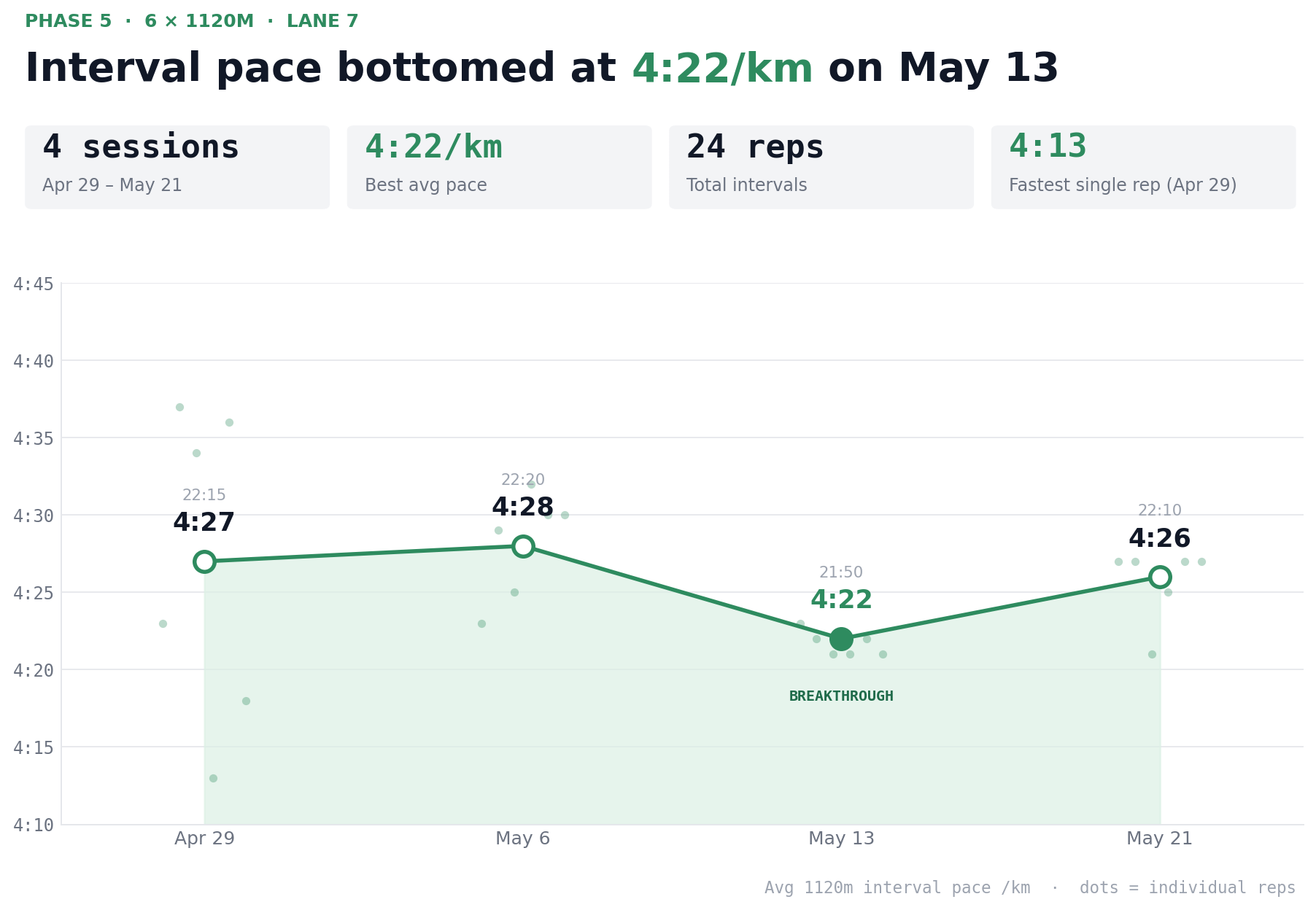
Apr 29: 4:27/km average, 24-second spread. A front-loaded blow-up. I opened rep 1 at 4:13/km, the fastest single rep of the entire arc, then faded to 4:36 by rep 6. A new ceiling but no sustainability.
May 6: 4:28/km average, 9-second spread. Controlled negative split. Rep 6 was the fastest rep of the day.
May 13: 4:22/km average, 2-second spread. Six reps between 4:21 and 4:23. The cleanest, fastest workout of the whole arc. The session that suggested 22:30 was on the table.
May 21: 4:26/km average, 6-second spread. An off day with heavy legs, ahead of taper. The body asking for a recovery week, which it got.
The middle two weeks, May 13 in particular, are why this race had 22:30 legs.
The tune-up that predicted more
Three days before the race, I ran a 2.4km tune-up. Same IPPT distance I run before every race now, partly because it gives me a clean year-over-year comparison.
May 27 tune-up: 10:38 at 4:25/km average. 26 seconds faster over the same distance than the tune-up before parkrun #2. Twelve seconds per km faster. Stride length up 58mm from April. Vertical economy holding in the same band. Average HR 164, max 172, well under race-day cardiac ceiling.
The 4-sec/km gap from tune-up to race held last time. April 22 tune-up at 4:37/km predicted a 4:41/km race, which is exactly what happened. If the same conversion had held today, I would have raced at 4:29/km. That’s 22:25.
The race the tune-up predicted didn’t show up. The race I ran is the race I paced.
Same fade, fitter legs
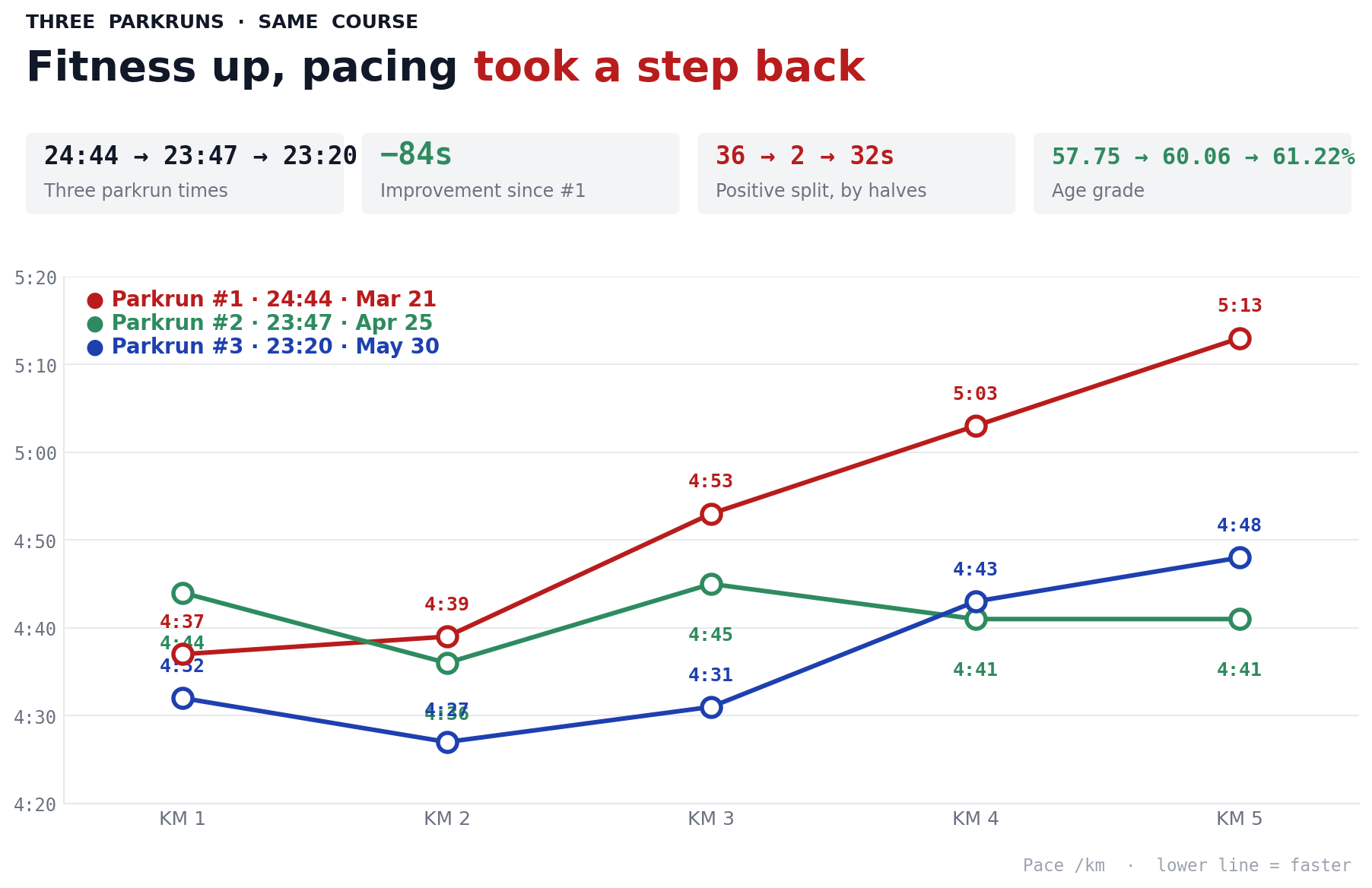
Three races on the same course. Three PBs. The fitness curve is monotonic. I’m 84 seconds faster over the same trail than I was on March 21, and roughly a percentage point higher on age grade.
The pacing curve is not monotonic. Parkrun #2 was the cleanest race of the three in this aspect. Today I opened more aggressively than parkrun #2 (4:32 vs 4:44) and produced essentially parkrun #1’s positive split (32 seconds vs 36). The shape of today’s race is the shape of my first ever parkrun, not my second. The discipline I taught myself in March didn’t carry through to today, mostly because the fitness underneath it changed and I didn’t recalibrate.
Pacing isn’t permanent
Pacing is a skill you re-execute every race, not a virtue you accumulate. The right opening pace at 23:47 fitness (4:44/km) is different from the right opening pace at 22:30 fitness (somewhere around 4:34/km). The shape of the discipline is the same. The numbers shift. And the calibration has to happen fresh every time you toe a line, because you only roughly know what your current fitness is.
The 4:30/km mile 1 today felt conservative. It felt the way 4:44/km would have felt in April. Against the 22:30 fitness I’d built, it was neutral, and 4:27 in km 2 was over the line. I was driving a faster car at the same throttle settings I’d learned on the slower one, and I overshot the corner.
The fix is small in mathematical terms and meaningful in mental terms. Open two to three seconds per km slower. Trust the fitness is there. Let the kick at the end produce the negative split that the discipline is supposed to enable.
I will write this down again in the next race plan and try harder to mean it.
Sub-20, still eventually
Sub-22:30 is the next gate. The fitness for it is already locked in. Today’s first half was 11:14, sub-22:30 pace held for 2.5km. The job is repeating it for another 2.5km, which means opening at 4:33-4:35/km and trusting there’s more in the second half than I expect.
Sub-22 is probably one more training block beyond that. Sub-21 is the gate that asks for a different kind of work. More weekly mileage, real strides, proper plyometrics, possibly some hill repeats. Sub-20 is several gates beyond, and still a long way off.
I wrote in the last post that the climb is patient, whether I am or not. That hasn’t changed. What’s changed is that today gave me a sharper picture of which gates need fitness and which gates need discipline. Sub-22:30 doesn’t need more training. It needs me to execute a plan I already know how to write down. Sub-21 will need both, and a lot more of one of them.
The honest version of where I am: I have 22:30 legs and 23:20 pacing. The fitness curve is doing its job. The pacing curve is mine to close, and it has to be closed in real time, while the race is happening, against a body that always wants to go faster than it should in the second kilometer.
You train for what you want to do. Today I trained for sub-22:30 and ran a 23:20 PB. Next time, I want to be patient enough to let the fitness do its job.
Sub-20 stays the north star. The slope today was steep in the wrong direction for one mile, and it cost me 30-45 seconds. The direction over the longer arc is still right. The process is still working. The pace will keep moving as long as the work keeps showing up, and as long as I keep relearning, race by race, what controlled means.