
You don't need more money. You need less want.
Three rules from a Big Tech lifer who walked away

“Commonsense” financial advice boils down to: earn more, invest better, grind harder. And most of it misses the point entirely.

I spent nearly two decades at Google. Good salary, good benefits, good trajectory. The conventional playbook said to keep climbing, keep earning, keep upgrading. Bigger house, nicer car, fancier vacations. More money equals more options equals more freedom. That’s the pitch.
Here’s what happened instead: my spending grew alongside my income, and my sense of freedom stayed flat. Every raise got absorbed. A slightly nicer car. A slightly better restaurant habit. A slightly more expensive hobby. None of it was extravagant on its own. All of it added up to the same feeling: I’m earning more and I don’t feel any freer.
A decade ago, the FIRE movement (Financial Independence, Retire Early) had an answer for this. Save aggressively, invest in index funds, retire in your 30s or 40s. The math was sound. But FIRE seems to have lost its energy, and I think it’s because the movement got stuck on the retire part. People optimized for an exit date and then discovered that “not working” isn’t a life philosophy. It’s a void. The interesting question was never “how do I stop working?” It was “how do I stop needing so much that work becomes a trap?”
That’s the question I’ve been living with. When I left Google to focus on family, writing, and the pursuits that matter to me, I didn’t have a grand financial masterplan. What I had was a philosophy I’d been assembling for years from books, from watching others, and from my own mistakes. Three rules.
Avoid lifestyle creep
Place asymmetric bets
Strive for less.
The reward is peace of mind. Not the Instagram version but the unglamorous kind where you wake up on a Tuesday and realize that nothing about your day is dictated by money.
The trap no one warns you about
Money is time. The economy makes that literal. Every dollar you spend represents time you traded away. Finite time. Time you’re not getting back. You don’t want to trade money you don’t need with time you do not have.
That $200 dinner? Five hours of your working life. That car upgrade? Four months. You stop asking “can I afford this?” and start asking “is this worth the hours I traded for it?” Most people never make that switch. As income rises, they face a choice they don’t even realize they’re making: save the difference, or spend the difference. Almost everyone spends it. Not deliberately. The culture treats spending as the default, and defaults are powerful.
This is lifestyle creep. Nobody sits down and decides they need a multi-million dollar house, multiple cars, and a $5,000 couch. It just happens, the way weeds take over a garden. Through inattention.
Seneca, a Stoic philosopher, had a practice for this. He’d deliberately live in poverty for a few days: rough clothes, less food, a hard surface to sleep on. Not as self-punishment but as calibration. He wanted to know: how small is the actual gap between “enough” and “comfortable”? Smaller than you think. Much smaller.
I stumbled into my own version of this when I started training for ultramarathons. I stripped back a lot, not for philosophical reasons but because the training demanded it. Early mornings on trails. Simple meals. Fewer social obligations. More sleep. And then a funny thing happened: I didn’t miss any of it. The stripped-back version of my life felt better than the padded one. That was unexpected. It also made me wonder how much of my spending had been solving problems I didn’t have.
Asymmetric bets
The second rule sounds like finance jargon. It’s not. An asymmetric bet is any decision where the worst case is small and survivable, and the best case is big. I talk about this more in The 80/20 rule for your whole life.
Leaving Google looks risky from the outside. But think about the actual downside: I had savings, I had marketable skills, and if everything went sideways I could go find another job. That’s a bounded downside. The upside? Time with my kids during years that don’t come back. Creative work that builds on itself. Space to think without a performance review shaping what I think about. Unbounded.
William Green, in Richer, Wiser, Happier, describes how the best investors think this way. They buy assets when the price is well below what they’re worth. Buy low, who would’ve thought eh? Pay $60 for something worth $100 and you have a $40 cushion. It can drop and you’re fine. But if it rises to true value or beyond, you do well. The key insight: great investors don’t chase big returns. They avoid catastrophic losses and let compounding handle the rest.
This extends way beyond the stock market. Every skill you learn is an asymmetric bet. Fix your own plumbing once, and you save $75 an hour for the rest of your life. Learn to cook properly, and you save thousands a year, forever. Each skill widens the gap between what you need to earn and what you need to spend. That gap is freedom.
The same logic shapes my crypto and options positions, my Substack writing, and turning parts of it into a book. None of these are moonshots. They’re small bets with long tails: bounded downside, compounding upside, and the patience to let them run.
Striving for less
This is the hardest rule. The entire culture pushes against it. “Striving for less” sounds like giving up. I’d argue it’s the most aggressive financial move you can make.
The math is embarrassingly simple: a dollar saved is worth more than a dollar earned. Saved money isn’t taxed. In the 30% bracket, you need to earn $1.43 to keep $1. A dollar you don’t spend is a full dollar retained. Frugality literally has a better return than a raise.
But the math isn’t the hard part. The hard part is knowing what “enough” looks like for you, specifically, before the culture tells you it should be more.
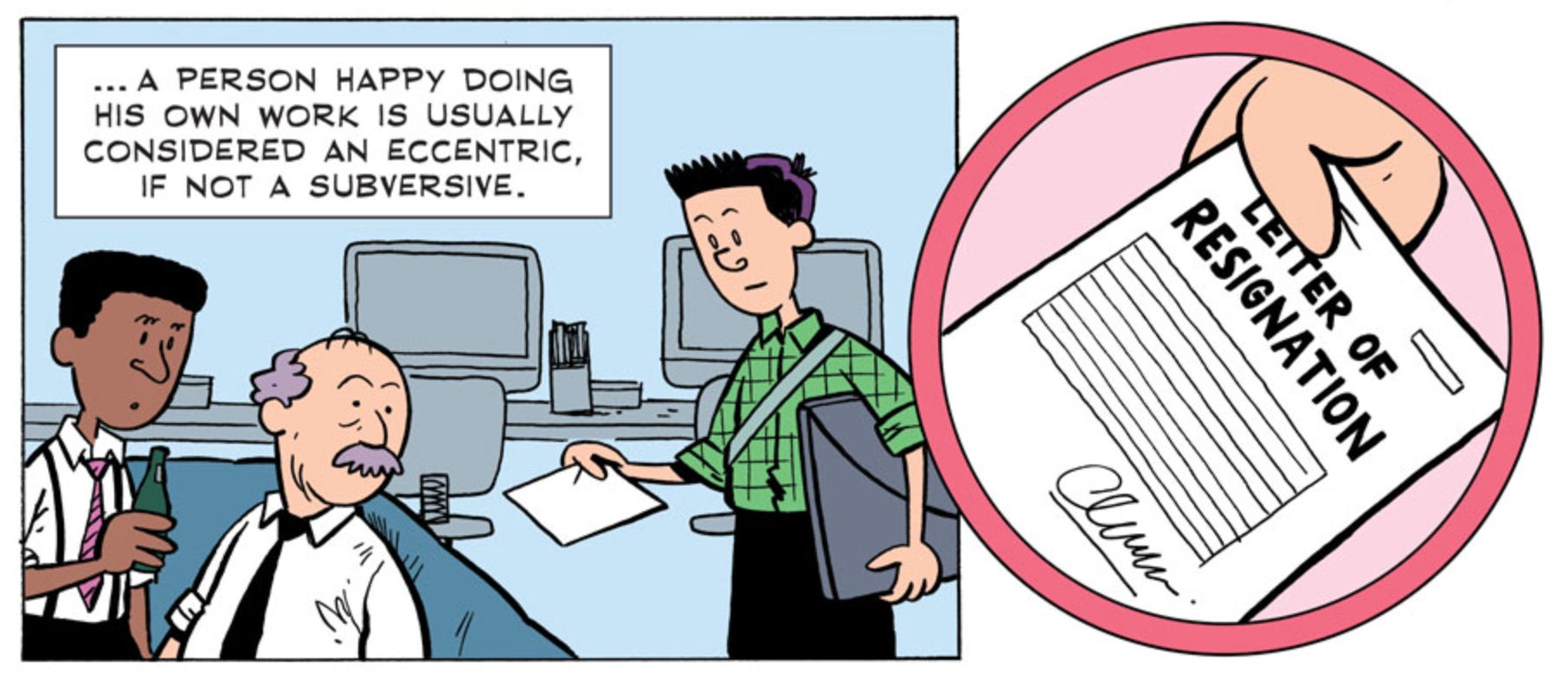
It’s funny how “giving up” and “waking up” can look exactly the same from the outside.
The old personal finance wisdom said happiness plateaus around $75,000-$100,000 in income. But recent research from Matthew Killingsworth at Penn says otherwise: happiness keeps rising with income, with no clear ceiling, even well past $500,000 a year. The data is hard to argue with.
But look at why money keeps making people happier. The biggest driver isn’t nicer stuff. It’s control. Security. Freedom over how you spend your time. That’s the finding that matters here, because it’s exactly what financial independence gives you, and you can get there much faster by needing less than by earning more. (I wrote more about the relationship between money and happiness in Money won’t fix your life. It reveals it.)
The trap is confusing the two. More income spent on more stuff doesn’t buy you more control. It buys you more complexity. A bigger house means more furniture, more cleaning, more insurance, more worry about property values. Each purchase spawns costs that weren’t in the original plan. The thing you bought to simplify your life made it more complicated. And now you need the income to maintain it all, which is the opposite of control.
The wealthiest investors I’ve read about, Buffett, Templeton, Howard Marks, all live well below what their net worth would allow. Not because they’re cheap but because they understand that peace of mind compounds too. And anxiety about money doesn’t go away when you have more of it. It just changes shape.
Financial independence works the same way. It’s not about hitting a number. It’s about reaching the point where money stops being the thing that decides what you do with your day.
What it looks like
I should be honest about what financial independence looks like in practice, because it’s not what the blogs promise.
I wake up. I run trails. I write. I spend time with my family. I mess around with code projects that interest me. I read. I sit and think, sometimes for a long time. None of this is glamorous. None of it would make a compelling LinkedIn post. But every day feels like it’s mine, and I spent enough years where that wasn’t true to know it’s worth protecting.
The three rules again:
Avoid lifestyle creep. Question every recurring expense. Periodically reset your baseline by stripping back to less, on purpose, and noticing how little you miss.
Place asymmetric bets. Learn skills, build assets, take positions where the downside is small and the upside compounds over time.
Strive for less. Define your “enough” before the culture defines it for you.
You don’t need to live on $7,000 a year. You don’t need to retire at 33. You need to close the gap between what you earn and what you spend, widen it over time, and invest the difference in things that grow quietly while you’re not watching.
What a great post. The phase “peace of mind compounds too” is really true. Thanks for sharing your journey.
Thanks for sharing. I feel like having a second kid was a breakthrough for me, where the pressure to get a biggerhousebiggercarmoremoney became unbearable, so I recalculated our FIRE numbers and instantly found so much more breathing room. The small house and 9yo cars are fine if it means we can be financially independent sooner in five years instead of 15. For some reason that was the first time that freedom as a function of desires and expectations clicked for me. Sure, vacations at the Four Seasons sound nice, but do they sound nicer than bowing out of the workforce entirely? No.
PS. I had no idea you left Google.