

This series of articles is part of my journey aiming for a sub-20min 5K. See my previous articles chronicling 24:43 → 23:47 → 23:20 → 23:35 (this article).
After parkrun #3 I wrote the fix down: pace better. I had 22:30 legs and 23:20 pacing. The job was to open two to three seconds per km slower, trust the fitness, and let the second half come to me. I said I’d write it down again and try harder to mean it.
I meant it. I spent six weeks fixing it, and the pacing is fixed.

I ran event #26 at Sunnyvale Bay Trail, my fourth parkrun, in 23:35. My first non-PB of the series with a 26-second positive split, and 16 seconds slower than the 23:19 PB I set in May.
Same course, same race, but different result. Let’s go with “failure” for the purposes of this series even though at the end I continue to be enormously thrilled with the state of my running.
In any case, I fixed the exact thing I set out to fix and ran slower anyway, and that deserves an honest accounting.
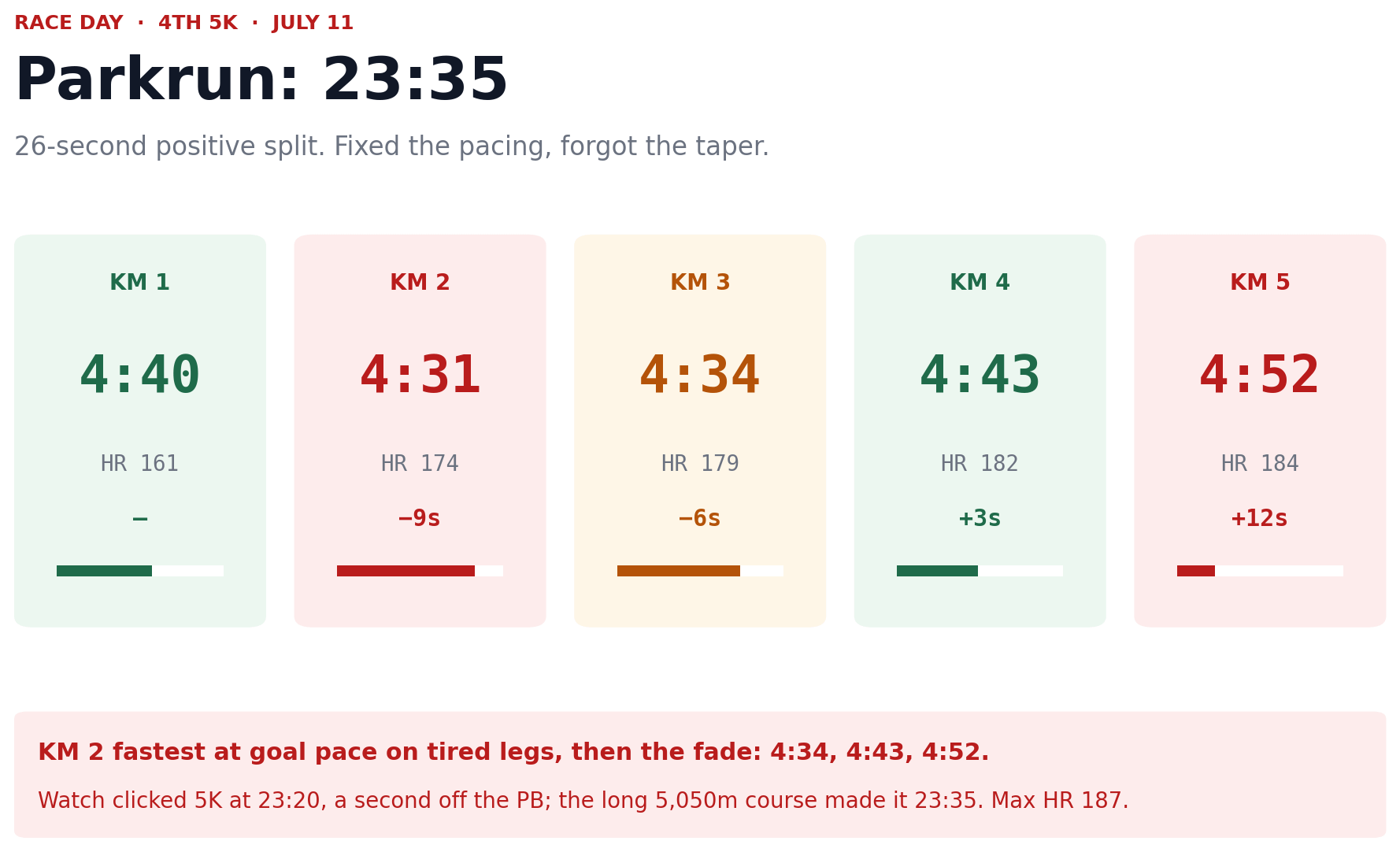
KM 2 dropped to goal pace on tired legs, then the floor gave way. Two red cards: one at the fast end and one at the slow end, both from the same missing thing.
What exactly is threshold?
The block started with a question about a word: threshold. My watch told me my lactate threshold pace was 7:26 per mile. That is 4:37/km. That is also, to the second, my 5K race pace.
Those two numbers can’t be the same since threshold is the pace I can hold for an hour while 5K pace is the pace I can hold for 20+ minutes and no more. If they’re equal, one of them is a lie, or I need a way better aerobic base.
I trusted the watch for a few months now but it seems to be the lie. Every “threshold” session I’d run was faster than my real 5K pace and so I wasn’t training threshold. I was running short VO2max intervals, calling them tempo, and then wondering why I couldn’t hold “threshold” for a full race.
I now think that my real threshold is around 4:46/km (7:40/mi). And once I had the right number, the sessions changed. Slower reps, shorter recovery, held even, finishing like I could do one more. For the first time the word on the plan matched the effort in the legs.
The good pacing
Once I got the right threshold pace, my intervals stopped front-loading.
June 3, 6×1km, I opened at 4:14/km (6:49/mi) and spent the next five reps paying for it, a 16-second spread from fastest to slowest. Then the recalibration took hold. June 10, five reps at my real threshold, 4:50/km (7:47/mi), held inside a three-second band, finishing like I could do one more.
July 1, 3×1600m at goal pace, 4:31/km (7:16/mi). Three reps within four seconds of each other, and my heart rate never touched threshold on any of them. I ran goal 5K pace and my heart barely noticed.
And the one that mattered most. On June 17 I went to the track and tried to run a 5K flat, on purpose, at goal pace. I held it dead even at 4:37/km (7:26/mi) for two miles before my heart rate hit its limit and I pulled out. I didn’t finish the distance. But I ran the most disciplined two miles of my life. The skill I’d been chasing since March finally showed up.
The discipline gate from parkrun #3. Closed. In training, at least.
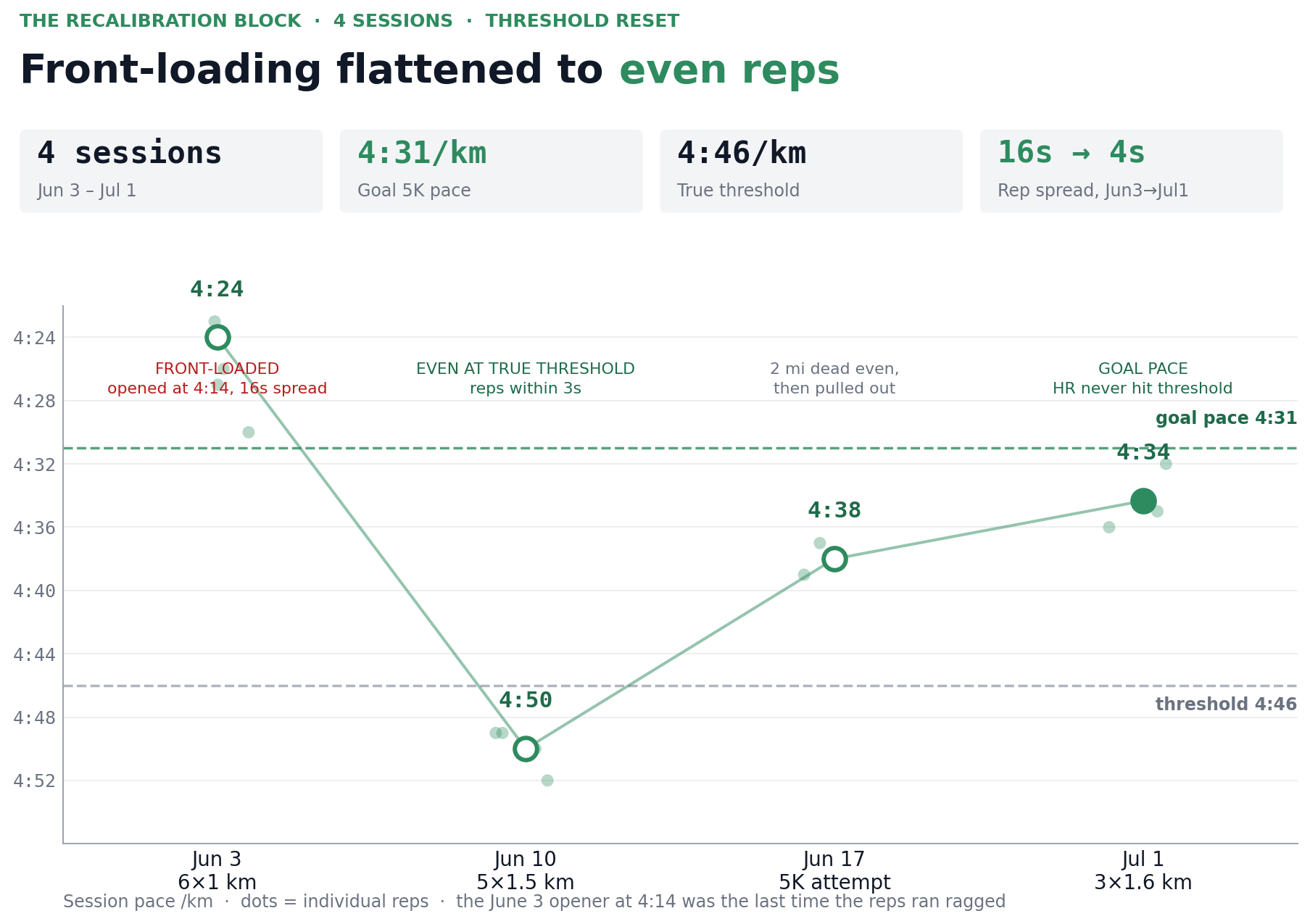
Once I trusted the right threshold number, the reps stopped front-loading. June 3’s 4:14 opener was the last ragged one. By July 1, three reps sat inside four seconds at goal pace, with the heart rate to spare.
The 2.4km tune-up
Three days out, the 2.4km tune-up. Same IPPT distance I ran before every race in my army days in Singapore, two decades and change ago.
2640m at 4:27/km (7:10/mi), run as a negative split, heart rate capped right at threshold across the line. My +4s/km tune-up-to-race rule predicted a 4:31/km race. That’s 22:35 for 5K. The best readiness signal I’d ever produced, and it said sub-22:30 was possible.
I’d read this paragraph before. Before parkrun #3, the tune-up predicted 22:25 and I ran 23:20. The tune-up promised more than the race delivered.
But it happened again and this time the pacing wasn’t the reason.
The race, and the course underneath it
Mile 1 at 4:38/km (7:27/mi). More conservative than parkrun #3’s 4:32. One aspect I am quite happy with is the discipline to open right and not overcook it at the beginning. I’d learned that much.
Then km 2 was my fastest kilometer of the day, and from KM 3 the floor gave way: 4:34, 4:43, 4:52 (7:21, 7:35, 7:50/mi). Cadence fell from 188 to 174. Stride shortened. The same collapse in lockstep I described three races ago, in the same order, at roughly the same point on the course.
KM 2 wasn’t reckless. 4:31 is my goal pace, the pace I held three times on July 1 without my heart rate reaching threshold. On fresh legs it would have been fine. On the legs I brought today it was already too much, and I had no second half to absorb it.
A word on the clock. Sunnyvale Bay Trail runs long on gravel: my Garmin measured 5,050m, about fifty past the line. The watch clicked 5K at 23:20, a single second slower than my 23:19 PB, and the official chip time read 23:35.
Max HR 187, one beat past the 186 from parkrun #3, the highest I’ve ever recorded. I emptied the tank. 23:35.
This is why I am quietly not disappointed with my performance. Even if it didn’t meet my expectations, it feels good that I gave it a good shot.
The wall at two miles
The equation doesn’t balance. Every session in this block said I was fitter than my May PB. I ran 16 seconds slower than it, at full effort. So despite fitter legs, I had a slower race.
The easy story is that I showed up tired as suggested by multiple chatbots. I don’t fully buy it, and I can’t fully clear it either. I ran about 30 miles the week before, under my usual 40-plus, so nobody overtrained me into this. But a down week isn’t a taper, and I ran a near-max 2.4km three days out. That tune-up predicts the race and fatigues me for it in the same breath. I banked the prediction and waved off the cost. So freshness probably isn’t the whole story. I won’t pretend it’s none of it.
Here’s the line I want to be careful with. I keep calling 4:31 the pace I can sustain, but I don’t. I can run 4:31 for a mile, three times, with rest in between. What I can sustain for 5K is what I raced: about 4:40. The gap between 4:40 and 4:31 isn’t durability sitting there waiting to be let out. It’s fitness I don’t have yet. That’s fine. It’s a different claim, and the tidy one was flattering me the way the intervals did.
So where does it break, and why. KM 2 and 3 held near goal, 4:31 and 4:34. Then 4:43, then 4:52. The floor gave way a little past two miles. June 17 broke at the same place: two even miles at 4:37, then my heart rate spiked and I stepped off.
Two readings fit that, and they pull in different directions. One is durability: the pace is there, I can’t hold it long enough yet, so I stretch it. The other is less flattering: goal pace sits above the aerobic ceiling I can hold for 5K right now, and my heart rate hitting 187 at the wall, a max reading over the past few months, is that ceiling announcing itself. The durability read says to extend the pace I have while the ceiling read says the pace has to come down to me as I get fitter, not be forced now. I’ve been telling myself the first while the heart-rate number says take the second seriously.
I think this means that I have miscategorized where I needed to improve: it isn’t a pacing issue that is preventing me from hitting sub-22:30. It’s my fitness or durability to sustain that pace for 5K.
The trail base is part of how I fooled myself. Forty miles a week of trails for almost a year should have built a deep aerobic engine, and I read that engine as 5K fitness. It isn’t. Aerobic volume and race-specific fitness are different things, and I’d been banking one and spending it like the other.
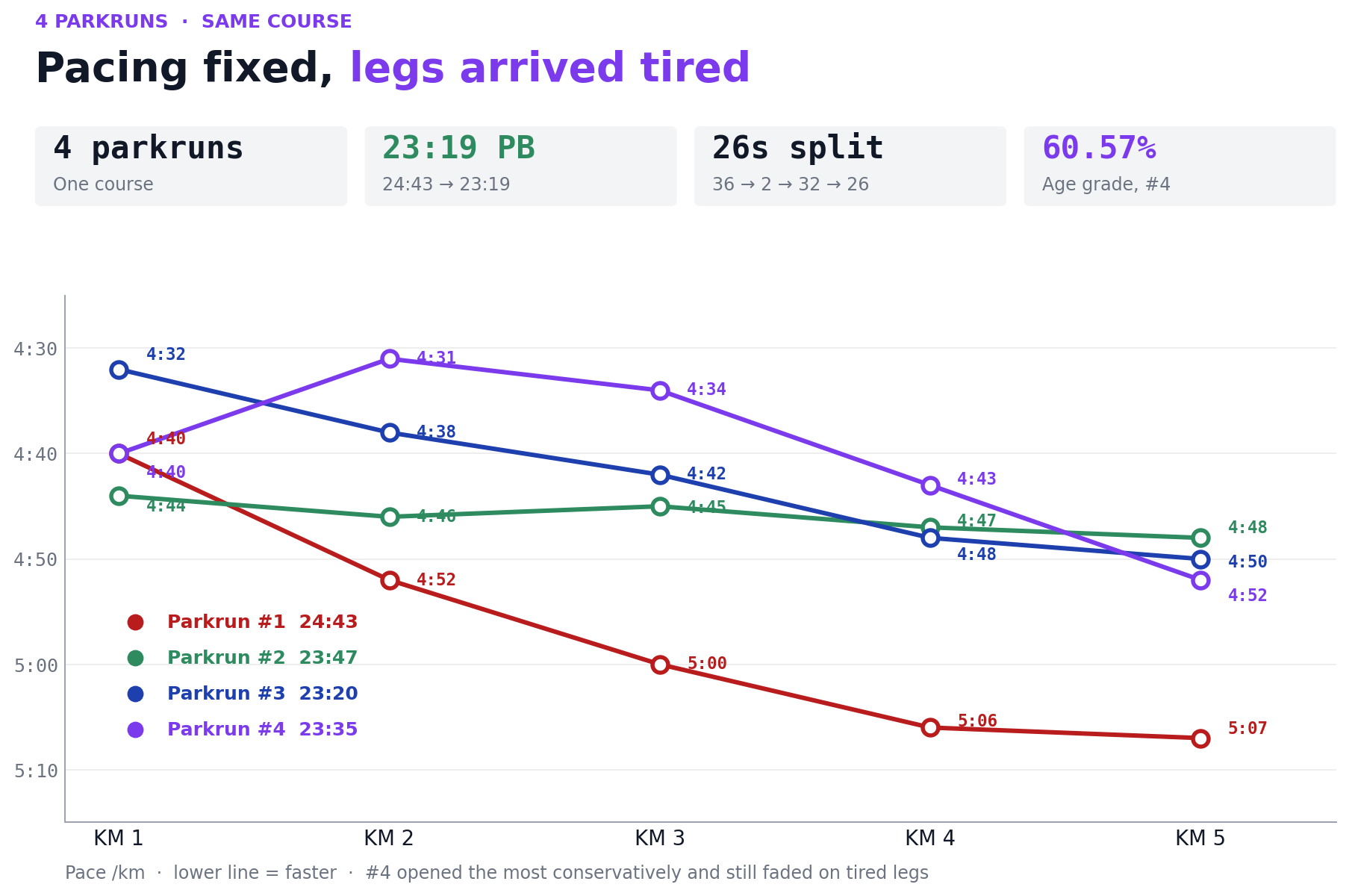
Four races, one course. #4 (purple) opens the most patient of the lot, dips to a 4:31 second kilometer, then climbs to the slowest last kilometer of the day. The fade didn’t leave. It moved out past two miles.
Sub-22:30, still, and closer than the clock says
The honest version of where I am has changed since parkrun #3. Then I thought it was 22:30 legs, 23:20 pacing but it isn’t. The pacing is a solved skill, and that’s progress worth banking. The next step is to train my 4:40 5K fitness into a 4:31 one. That’s fitness to build, not fitness I’m failing to express.
The good news is that endurance and aerobic ceiling are both trained by the same work: dragging the pace I can hold for twenty-odd minutes downward until goal pace fits under it. So the next block doesn’t hinge on getting the diagnosis exactly right. Fewer short reps with generous rest, more continuous work at 5K effort: mile repeats off short recovery, tempo at the edge of comfortable, race-pace runs long enough to find the wall and lean on it.
The north star
Three parkruns, three PBs. The fourth broke the streak, and it taught me more than the three that didn’t. A PB tells you the process worked. A non-PB tells you where the process wasn’t quite sharp enough.
The speed for a mile is there. The fitness to hold 5K pace for a whole 5K isn’t, and I don’t yet know whether the limiter is endurance or a heart rate ceiling that goal pace sits above.
Sub-20 stays the north star. Sub-22:30 needs one thing from me now, and it isn’t a mile of speed and it isn’t pacing. It’s the fitness to hold the effort for all five kilometres instead of two. You train for what you want to do. Today I trained for a fast two miles and ran a fast two miles. Next time, I want to have trained for the whole five.